
Legal keywords on Google are among the most expensive worldwide. For instance, “personal injury lawyer” costs $50 to $200 per click, and “car accident attorney” often costs more than $150. Despite these high costs, many law firms use broad keywords, generic landing pages, and lack attribution to track which clicks lead to signed retainers.
As a result, firms frequently spend thousands of dollars each month without clearly understanding their ROI.
This guide outlines how to run profitable Google Ads for law firms. It explains how the platform works for legal practices, what sets effective campaigns apart, common mistakes, and examples of successful management.
What Are Google Ads for Law Firms?
Google Ads is a paid search platform that places your firm at the top of search results when potential clients seek legal help. Unlike SEO, which can take months to build rankings, Google Ads deliver immediate visibility from the first day your campaign launches.
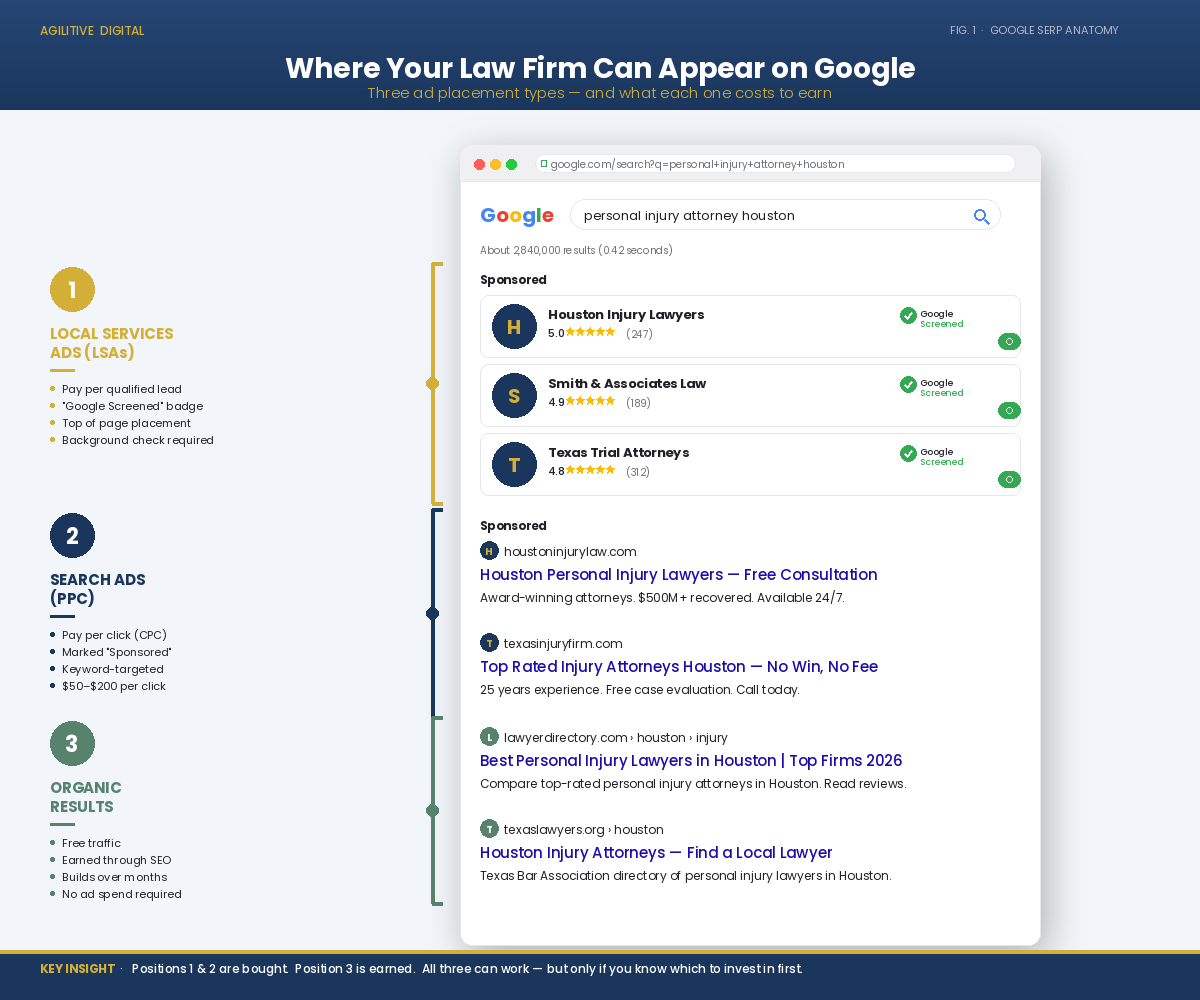
For law firms, Google Ads operates in three main formats. Search ads appear above organic results for queries like “best DUI attorney near me.” Google Local Services Ads (LSAs) display above standard search ads and feature the Google Screened or Google Guaranteed badge, which increases click-through rates. Display and remarketing ads re-engage website visitors who did not convert initially.
The main difference between law firm PPC and general advertising is user intent. Individuals clicking legal search ads are actively seeking representation for immediate legal needs. This intent makes Google Ads highly effective for acquiring new cases when campaigns are well structured.
Why Google Ads Matters for Law Firms?
The stakes for missing the top of Google’s search results are higher than ever. Ninety-six percent of people seeking legal advice start with a search engine, and most do not look beyond the first three results. If your firm is not visible, those clients will contact competitors.
Paid search traffic converts three to five times higher than organic for high-intent queries because the searcher’s need is immediate. Someone searching “emergency family law attorney Dallas” is not researching; they need help now.
The impact is significant. A personal injury firm averaging $15,000 per case that misses only two consultations per month loses $30,000 in potential revenue, which far exceeds any management fee.
Competition is increasing. Legal ad spend on Google grew 22% year over year from 2022 to 2024, making auctions more expensive. Firms that build efficient campaigns now gain a lasting cost advantage over those who enter later.
How to Build a High-Performing Law Firm Google Ads Campaign?
Step 1: Structure Your Campaigns Around Practice Areas, Not the Firm
The most damaging structural mistake in law firm PPC is combining all practice areas into a single campaign. Personal injury, criminal defense, family law, and estate planning attract different searchers and have unique needs, average case values, and acceptable cost-per-lead thresholds.
Create separate campaigns and budgets for each practice area. A personal injury firm can justify a $150 cost-per-lead because of typical contingency fees, while a family law firm billing hourly may need leads under $80. Combining them in one campaign makes it impossible to optimize either effectively.
Step 2: Target the Right Keywords and Block the Wrong Ones
High-intent keywords for attorney Google Ads follow a consistent pattern: practice area plus attorney, lawyer, or firm, plus a location modifier. Examples include “car accident lawyer Houston,” “divorce attorney near me,” and “criminal defense attorney Chicago.” These are the queries that convert.
Your negative keyword list matters just as much. Without it, your ads may appear for searches like “how to represent yourself in court,” “law school scholarships,” and “free legal advice,” none of which will become paying clients. Agilitive Digital builds negative keyword lists of 200 to 400 terms before launching any campaign, filtering out educational queries, competitor brand names, and job-related searches. This step alone typically reduces wasted spend by 25 to 40%.
Step 3: Build Dedicated Landing Pages for Each Ad Group
Sending paid traffic to your firm’s homepage is one of the most costly mistakes in law firm PPC. The homepage introduces your firm broadly, while a landing page built for a specific ad group, such as “truck accident attorney Dallas,” is designed to generate a consultation request from someone with that specific legal need.
Dedicated landing pages consistently outperform homepages by 40 to 80% in conversion rate for legal campaigns. Each page should feature a compelling headline matching the search query, social proof such as reviews, case results, or bar credentials, a simple intake form, and a prominent phone number with click-to-call functionality.
Step 4: Set Up Conversion Tracking Before Spending a Dollar
Running Google Ads without conversion tracking is not marketing; it is guessing. Your campaigns must track every phone call, form submission, and chat interaction that originates from an ad click. Without this data, you cannot determine which keywords generate consultations, which ad copy drives calls, or which landing page variants convert at higher rates.
Connect Google Ads to Google Analytics 4 and set up call tracking with a platform such as CallRail. Map every conversion to its original keyword and ad. This data infrastructure transforms PPC from a cost center into a measurable revenue driver.
Step 5: Add Google Local Services Ads Alongside Search Campaigns
Google LSAs deserve special mention because they operate differently from standard search ads. LSAs appear at the top of the results page, above both standard ads and organic listings, and charge per lead rather than per click. For qualifying law firms, LSAs often deliver the lowest cost per consultation of any paid channel.
Qualification requires a background check, license verification, and insurance confirmation from Google. The process takes two to four weeks but is well worth the time. The Google Screened badge displayed on LSA listings signals credibility to potential clients at the moment of highest intent.
Stop guessing with your ad budget. Contact us today to learn how we turn clicks into signed retainers.
Common Mistakes Law Firms Make With Google Ads
1) Setting Campaigns Live and Leaving Them Alone
Google Ads requires weekly bid adjustments, search term reviews, and pausing underperforming ads. Unattended campaigns tend to waste budget as automated bidding optimizes for clicks rather than consultations. This is why Agilitive Digital reviews every client account weekly.
2) Bidding on overly broad keywords
Terms like “lawyer” or “attorney” attract irrelevant traffic. Tightly defined phrase-match and exact-match keywords, such as “personal injury attorney Los Angeles,” convert better and cost less.
3) Ignoring Quality Score
Without dedicated PPC tracking numbers, firms cannot identify which campaigns or keywords generate calls, leading to budget decisions based on guesswork rather than data.
4) No call tracking or attribution
Without dedicated PPC tracking numbers, firms can’t identify which campaigns or keywords generate calls, leading to budget decisions based on guesswork instead of data.
5) Stopping campaigns during slow periods
Pausing ads on weekends or during slower months removes your firm from search results when prospects are actively searching. Maintaining a consistent presence strengthens auction performance.
What Can Law Firms Actually Achieve With Google Ads? Real Results
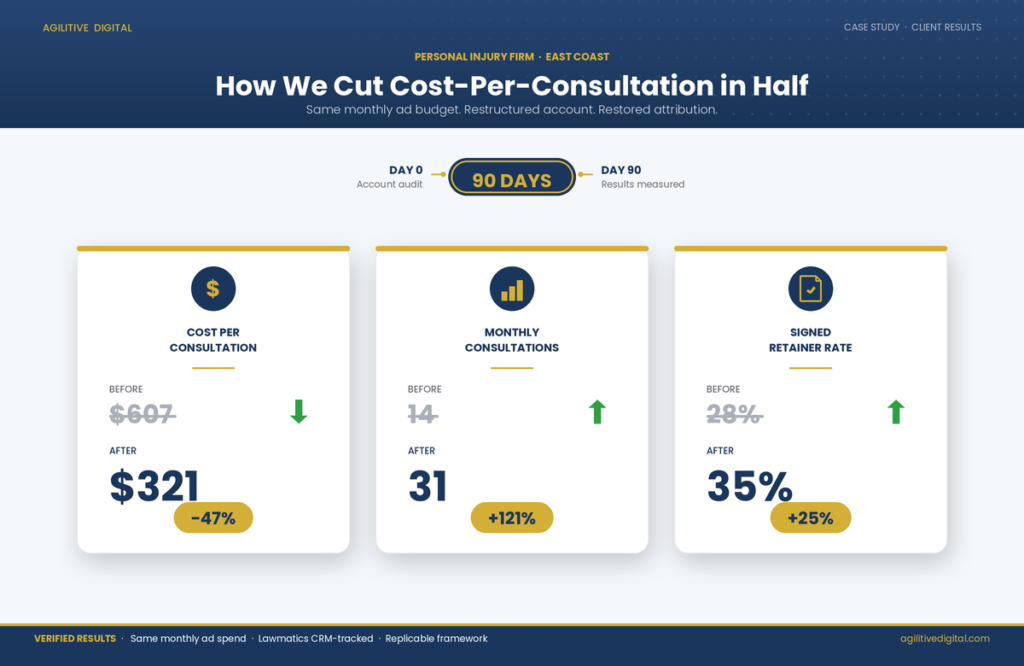
The Problem: A personal injury firm on the East Coast was spending $8,500 per month on Google Ads managed by a generalist agency. They generated about 14 consultations per month, at a cost per consultation of just over $600. Their signed retainer rate was 28%, resulting in a cost of nearly $2,200 per new client.
The Approach: Agilitive Digital audited the account and found that 43% of ad spend went to broad-match keywords unrelated to active legal needs. The campaign used only one landing page, the firm’s homepage. The account had no call tracking, no negative keyword list, and Quality Scores averaged 4 out of 10.
The account was restructured into five practice area campaigns, each with dedicated landing pages. We implemented a 300-term negative keyword list. We integrated call tracking with the firm’s Lawmatics CRM. Quality Scores improved through tightly aligned ad copy and landing page content.
The Result: Within 90 days, cost per consultation dropped from $607 to $321. Monthly consultations increased from 14 to 31 on the same budget. The signed retainer rate improved to 35% as lead quality increased. Managing over $10 million in legal ad spend, Agilitive Digital consistently achieves results in this range, which is why our client retention rate is 94%.
Google Ads Quick-Start Checklist for Law Firms
Use this before launching any new campaign:
- Campaign structure: Separate campaign for each practice area
- Keywords: Phrase-match and exact-match only, no broad match without a robust negative list
- Negative keywords: Minimum 150 terms covering educational, job, and self-help queries
- Ad copy: Minimum 3 responsive search ad variations per ad group, headlines mirroring the target keyword
- Landing pages: Dedicated page per practice area with headline matching ad copy
- Conversion tracking: Phone calls (calls from ads + website calls), form submissions, and chat tracked separately
- Call tracking: Dedicated PPC phone number connected to CRM
- LSA eligibility: Confirm your practice area qualifies and begin verification process
- Quality Score target: Aim for 7+ across all keywords before scaling budget
- Review cadence: Weekly search term review, bi-weekly bid adjustment, monthly performance report
FAQs
Conclusion
Google Ads provides law firms with immediate visibility for high-intent searches when campaigns are structured around practice areas rather than the firm as a whole. Negative keywords and conversion tracking are essential; without them, you fund Google instead of your growth. Optimizing Quality Score can reduce CPC by up to 50% and improve placement. Running Google LSAs alongside standard search campaigns ensures maximum top-of-page coverage. A well-managed account tracks exactly which keywords generate consultations, their cost, and ROI.
At Agilitive Digital, we focus exclusively on law firms and manage over $10 million in ad spend with a 94% client retention rate. We turn qualified consultations into signed retainers and prioritize revenue over vanity metrics.
Ready to discover where your current Google Ads budget is being wasted? Request your free PPC audit from Agilitive Digital. We will show you what is costing you cases and exactly how to fix it.