
Your law firm’s website converts 4% of visitors into form fills. Your intake team converts 20% of those form fills into signed retainers. Do the math. Every 100 visitors produce less than 1 client. And the CRO agency your firm hired spent the last quarter A/B testing button colors.
That is the reality most managing partners never see clearly. The “conversion rate” being reported in monthly marketing dashboards measures a step of the funnel that does not correlate with revenue. Cases are won or lost in the intake conversation, in the speed of the callback, in the qualification questions your team asks. Your website is the front door, not the closing table. Yet 90% of conversion rate optimization for law firms is spent optimizing the door.
At Agilitive Digital, we have managed over $10M in ad spend exclusively for law firms, and the pattern is consistent: firms with average websites and elite intake operations outperform firms with beautiful websites and mediocre intake by 3 to 5 times on signed retainer count.
This article introduces a framework built on that reality. It rejects the e-commerce playbook that dominates CRO advice online, and replaces it with a methodology designed for the way legal buyers actually convert.
Quick Answer
Conversion rate optimization for law firms fails when it treats the website form as the finish line. Signed retainers actually happen through a longer path: from click to form fill to intake conversation to consultation to signed engagement. The Intake-First Framework optimizes every stage of that path, not just the first click. Firms operating the full framework convert 3 to 5 times more retainers from the same traffic volume.
Why Generic CRO Fails for Law Firms?
Conversion rate optimization as a discipline was built for e-commerce. The tactics were refined on companies like Amazon, Shopify stores, and SaaS trial signups, where the moment a customer clicks “buy” or “start free trial” is the moment revenue is created. Legal buyers do not work that way, and applying e-commerce logic to law firm websites produces three predictable failures.
Failure 1: Optimizing Form Submissions Instead Of Signed Retainers
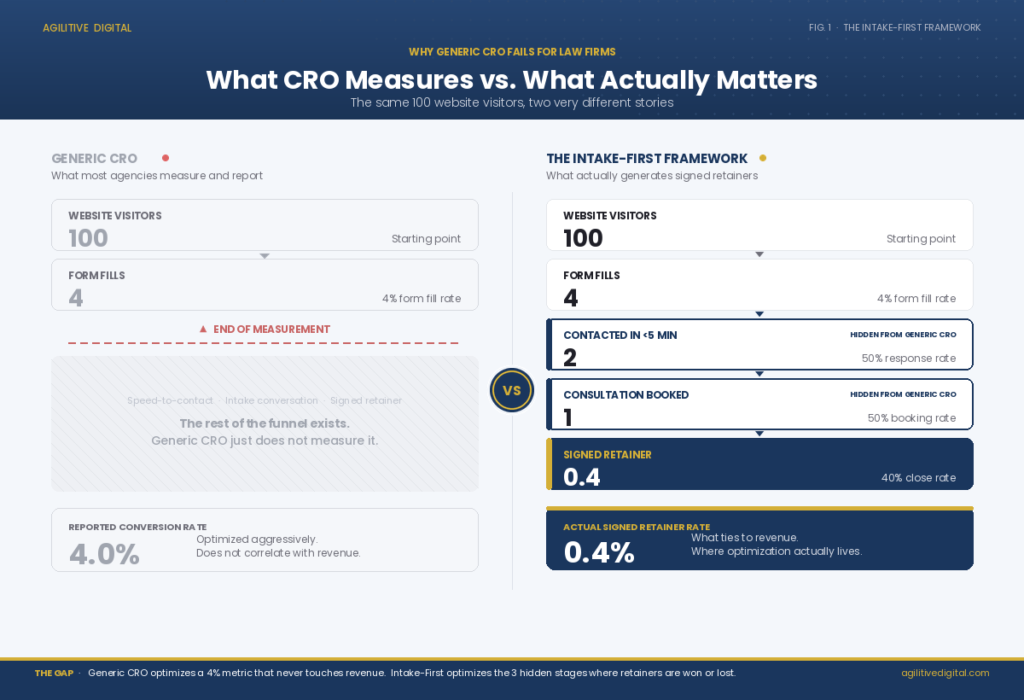
Generic CRO agencies report “conversion rate” as form submissions divided by visitors. That number tells you almost nothing about your firm’s revenue. A firm doubling its form fills while attracting worse-fit prospects will end up with the same number of signed retainers and a burned-out intake team. The metric that matters is signed retainers per dollar of ad spend, or per unit of organic traffic. Most agencies never track it because their tools cannot see past the form.
Failure 2: Applying “Reduce Friction” Logic Without Understanding Legal Buyer Psychology
E-commerce CRO wisdom says shorter forms convert better. This is often true when you’re selling a $40 t-shirt. It is dangerously wrong when you’re selling a $15,000 personal injury retainer. Legal buyers make high-stakes decisions and interpret friction as thoroughness. A firm that asks 8 qualifying questions signals seriousness. A firm that asks only for name and phone signals a lead-farm. Reducing form friction below a certain floor actively repels the high-value clients you want most.
Failure 3: Treating The Website As The Conversion Moment
Standard CRO tools like Hotjar and Optimizely measure what happens on the website. They cannot measure what happens after. But the conversion decision for legal buyers is made during the intake conversation, not during the website visit. A firm whose intake team answers calls in under 30 seconds with a warm, competent voice converts leads at 45 to 60% into consultations. A firm whose leads hit voicemail converts at 8 to 15%.
That five-times gap has nothing to do with the website and everything to do with an operational stage no e-commerce framework was built to optimize.
Introducing The Intake-First Framework
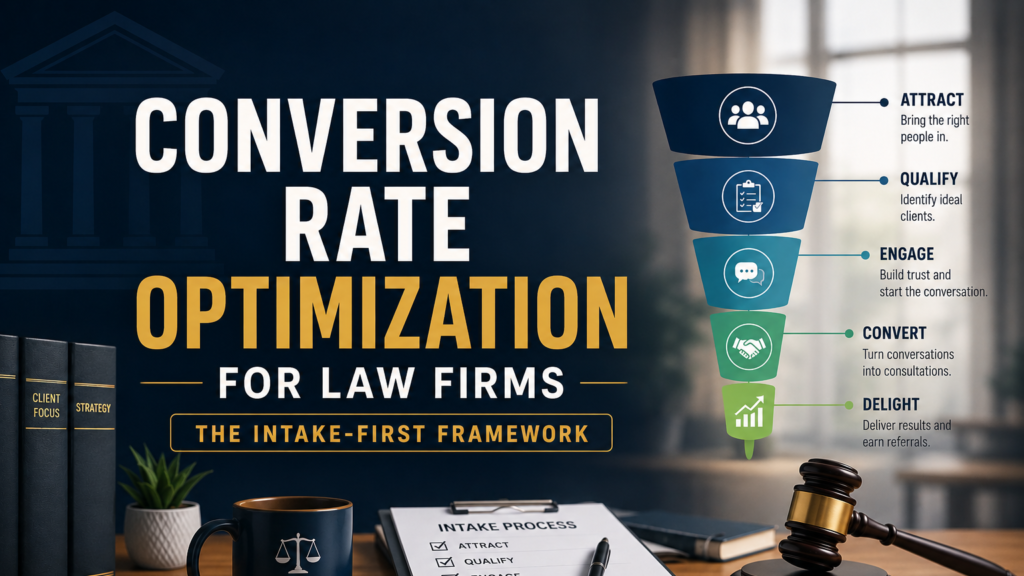
The Intake-First Framework is a five-pillar methodology for conversion rate optimization for law firms that treats the entire path from click to signed case as one continuous system. Its central insight: the most leveraged optimization in legal marketing is almost never on the website itself. It is in the operational stages between form submission and signed retainer, which generic CRO frameworks ignore entirely.
The five pillars, in the order a firm should build them:
- Attribution Truth: Measuring what actually produces signed retainers, not what looks like conversion.
- Qualification Design: Building website friction that attracts the right cases and repels the wrong ones.
- Speed-to-Contact: Optimizing the first 5 minutes after form submission, where 50% of retainers are won or lost.
- Intake Choreography:Engineering the intake conversation itself, which most firms treat as unstructured.
- Retainer Signing Path: Reducing friction between “yes I want to hire you” and “here is my signed agreement”.
Each pillar reinforces the others. A firm that gets Attribution Truth right but neglects Intake Choreography will produce cleaner data on the same poor outcomes. A firm with excellent Speed-to-Contact but no Qualification Design will burn intake capacity on junk leads. The framework works only when all five pillars operate together.
The 5 Pillars of The Intake-First Framework
Pillar 1: Attribution Truth
Attribution Truth is the foundation because you cannot optimize what you cannot measure. This pillar exists because generic CRO reports “conversion rate” as a website metric, when the metric that matters is cost per signed retainer, tracked back to the specific keyword, ad, or landing page that produced it.
Building Attribution Truth requires connecting three systems: your ad platforms (Google Ads, Meta Ads), your intake system (Lawmatics, Clio Grow, HubSpot), and your call tracking (CallRail with dedicated numbers per traffic source). Every form submission and phone call gets tagged with its source. Every consultation gets marked as qualified or not. Every signed retainer gets tracked back through the chain.
The insider detail most firms miss: use dynamic number insertion (DNI) with CallRail to swap phone numbers on your website based on traffic source. This lets you measure whether a call came from Google Ads, from organic search, or from a specific practice-area page. Without DNI, all your phone leads look the same, and 40 to 60% of your true conversion signal is lost.
At Agilitive Digital, we require every new client to establish full attribution tracking within the first 30 days of engagement. Firms that skip this step optimize the wrong things for the next six months.
Pillar 2: Qualification Design
Qualification Design is deliberate friction. This pillar exists because generic CRO agencies push firms to shorten forms and remove barriers, which increases form volume but decreases signed retainer rate. The goal is not more leads. The goal is more of the right leads.
For a personal injury firm targeting cases worth $50,000+ in average settlement value, an intake form should include qualifying questions: What type of accident? When did it happen? Have you filed a police report? Are you currently represented? Each question filters out low-value prospects (accidents outside the statute of limitations, minor property damage claims, people shopping for pro bono help) and pre-qualifies the ones that remain.
The insider tactic: use conditional logic to hide or reveal questions based on prior answers. A visitor who selects “car accident” sees follow-up questions about injuries and vehicle damage. A visitor who selects “estate planning” sees a completely different question set. Tools like Typeform, HubSpot Forms, or Gravity Forms with conditional logic add-ons handle this. Static forms treat every visitor identically, which loses the qualification signal your intake team needs to prioritize responses.
Qualification Design directly reinforces Pillar 3 (Speed-to-Contact) by pre-flagging high-value leads for immediate response.
Pillar 3: Speed-to-Contact
Speed-to-Contact is the highest-leverage operational pillar in the entire framework. The Harvard Business Review’s often-cited study on lead response times found that firms contacting leads within 5 minutes are 21 times more likely to qualify the lead than firms contacting within 30 minutes [VERIFY current source]. In legal, where a personal injury victim is on Google filling out three forms simultaneously, whoever calls first often wins the case.
This pillar exists because generic CRO frameworks stop at “the visitor submitted a form.” What happens in the 5 minutes after is more predictive of a signed retainer than anything the website itself controls. And 80% of the law firms we audit have no formal SLA (service level agreement) for lead response time.
The insider tactic: build automation that alerts your intake team by SMS the moment a high-priority form submission arrives, with the visitor’s qualifying answers pre-populated so the intake specialist knows the exact case type before dialing back. Tools like Zapier, Lawmatics, or HubSpot workflows connect the form submission to the SMS alert to the CRM record in under 60 seconds. The lead gets a callback while they are still on your website.
At Agilitive Digital, we track speed-to-first-contact as a client KPI. Firms operating at under 5-minute average response times consistently outperform slower firms on signed retainer rate by 200 to 400%.
Pillar 4: Intake Choreography
Intake Choreography is the engineering of the conversation itself. This pillar exists because most law firms treat intake as an unscripted, personality-dependent activity, when the highest-performing firms treat it like a structured sales process. The gap between an elite intake specialist and an average one is the difference between a 45% consultation booking rate and a 15% consultation booking rate on identical leads.
Building Intake Choreography starts with a documented intake script that covers: opening warmth and acknowledgment, verification of contact information, case qualification questions in a specific order, expectations-setting about the consultation, and the calendar-booking close. Every element is deliberate. Every intake specialist follows the same script. Every deviation gets reviewed.
The insider tactic: record every intake call (with proper consent per state law) and review 5 to 10 calls per week per intake specialist. Score them against a rubric covering warmth, qualification thoroughness, and close attempt. Firms that implement call recording and weekly review increase intake conversation-to-consultation booking rates by 30 to 50% within 90 days.
Intake Choreography also handles compliance concerns that generic CRO ignores. Intake specialists trained on ABA Model Rule 1.6 (client confidentiality) and state-specific solicitation rules avoid the compliance violations that can trigger state bar discipline.
Pillar 5: Retainer Signing Path
Retainer Signing Path is the final operational pillar. It exists because a client who has verbally committed to hiring your firm can still walk away if signing the retainer requires driving to your office, printing documents, or navigating a confusing engagement letter. Generic CRO ignores this stage entirely because e-commerce never had it.
The mechanics: use e-signature tools (DocuSign, Adobe Sign, or Clio’s built-in e-signature) to send retainer agreements immediately after the consultation. Send the retainer while the client is still on the phone. Use plain-language summaries at the top of the agreement so the client understands what they are signing without needing a lawyer to explain it. Offer secure online payment for retainer deposits with tools like LawPay so the client can complete the entire signing process from their phone in under 10 minutes.
The insider tactic: build a “signing window” playbook that governs what happens if the client does not sign within 24 hours, 72 hours, and 7 days. Automated follow-up sequences with progressively different messages recover 15 to 25% of stalled retainers that would otherwise never sign. Most firms send one email after the consultation and hope for the best.
Retainer Signing Path completes the chain that Attribution Truth started measuring. Now you can trace a signed retainer all the way back to the specific ad that produced it, close the loop, and reinvest into what actually works.
How to Apply The Intake-First Framework to Your Firm?
The framework is designed to be diagnosed pillar by pillar, then fixed in a specific order based on where your firm is weakest.
Start with a self-assessment. For each pillar, ask yourself:
- Attribution Truth: Can you tell me, right now, which of your top 5 keywords produced the most signed retainers last quarter? If not, this is your biggest weakness.
- Qualification Design: Does your intake team spend more than 30% of their time on unqualified leads? If yes, this pillar is broken.
- Speed-to-Contact: What is your firm’s average time from form submission to first outbound call? If you do not know, or if it exceeds 15 minutes, this is a high-leverage fix.
- Intake Choreography: Do you have a documented intake script that every specialist follows? Do you review recorded intake calls? If not to both, you are leaving 30% of consultations on the table.
- Retainer Signing Path: What percentage of clients who verbally commit at consultation actually sign within 7 days? If under 75%, this pillar needs work.
Prioritize your fix in this order: Attribution Truth always comes first because you cannot measure improvement on the other pillars without it. Then fix whichever of the remaining four pillars scored worst. Do not attempt all five simultaneously. Firms that try to overhaul everything at once execute nothing well.
Expected timelines: Attribution Truth takes 30 to 60 days to implement fully. Qualification Design and Speed-to-Contact produce measurable improvements within 30 days of launch. Intake Choreography takes 60 to 90 days because it requires staff training and behavior change. Retainer Signing Path produces results within the first 30 days once implemented.
A firm operating the full framework typically sees signed retainer volume increase 2 to 4 times within 6 months, on the same website traffic.
Common Mistakes Law Firms Make with Conversion Optimization
Measuring Website Conversion Rate As If It Were The Whole Story
Why firms make it: Google Analytics reports website conversion rate prominently. Marketing agencies report it monthly. It feels like the KPI.
What it costs: A firm can double its website conversion rate while decreasing signed retainer volume if the additional leads are lower quality. Firms optimizing the wrong metric burn thousands per month rewarding the wrong behavior.
How to avoid it: Report signed retainers per traffic source as the primary KPI. Track website conversion rate as a secondary metric only. This is Pillar 1 in action.
Shortening Intake Forms To The Bare Minimum
Why firms make it: Generic CRO best practices say “reduce friction” universally.
What it costs: Shorter forms attract more leads, but a higher percentage of those leads are unqualified. Intake teams burn 40 to 60% of their capacity on prospects who will never sign, leaving less time to close high-value cases.
How to avoid it: Add qualification questions (with conditional logic) that filter for case type, timing, and readiness. Accept a lower form completion rate in exchange for a higher retainer close rate. This is Pillar 2 in action.
Letting Leads Hit Voicemail During Business Hours
Why firms make it: Reception staff answer the main line while intake specialists work on existing files. Nobody owns the incoming lead specifically.
What it costs: Leads that hit voicemail during business hours convert 5 to 10 times less often than leads answered live. On a firm generating 50 leads per month, this can mean 3 to 5 lost cases monthly worth tens of thousands in fees.
How to avoid it: Assign dedicated intake capacity to lead response during peak hours (typically 8am to 8pm local time). Use SMS alerts for immediate notification. This is Pillar 3 in action.
Treating Intake Conversations As Unscripted
Why firms make it: Firms hire “warm and empathetic” intake staff and trust their instincts to convert leads. Scripting feels cold.
What it costs: Unscripted intake produces wildly inconsistent conversion rates across staff. Top performers convert at 45%, weakest at 12%. The firm cannot systematically improve without a baseline.
How to avoid it: Document a structured intake script. Train every specialist on it. Record calls and review weekly. Warmth and structure are not opposites. This is Pillar 4 in action.
Sending Retainer Agreements As Pdf Email Attachments
Why firms make it: It is how firms have always done it.
What it costs: Every additional step between verbal commitment and signed agreement loses 10 to 20% of clients. A PDF attachment that requires printing, signing, scanning, and emailing back loses far more clients than an e-signature link the client can complete on their phone.
How to avoid it: Implement e-signature tools with mobile-optimized signing flows. Deliver the retainer within an hour of the consultation. This is Pillar 5 in action.
Real Results: How a Personal Injury Firm 3x’d Signed Retainers Using The Intake-First Framework
Client type: A mid-sized personal injury firm in the Southeastern US, handling motor vehicle accidents, premises liability, and workers compensation.
Problem: The firm was spending $18,000 per month on Google Ads and generating roughly 90 form submissions monthly. Their intake team was overwhelmed and reported that many leads were low-quality “shopping” prospects who never committed. Their attribution was broken (they could not tell which campaigns produced signed retainers), their intake team routinely let calls go to voicemail after 5pm, and their intake conversations had no structure.
Approach: Over 120 days, we implemented four of the five Intake-First Framework pillars:
- Attribution Truth: Implemented CallRail dynamic number insertion, connected Lawmatics to Google Ads via offline conversion tracking, and built a dashboard showing cost per signed retainer by campaign
- Qualification Design: Rebuilt the primary intake form with conditional logic covering case type, injury severity, existing representation, and timing since incident
- Speed-to-Contact: Deployed SMS alerts to a rotating on-call intake specialist for all form submissions, with a 5-minute response SLA
- Intake Choreography: Documented a structured intake script, recorded intake calls, and implemented weekly call review sessions for the three intake specialists
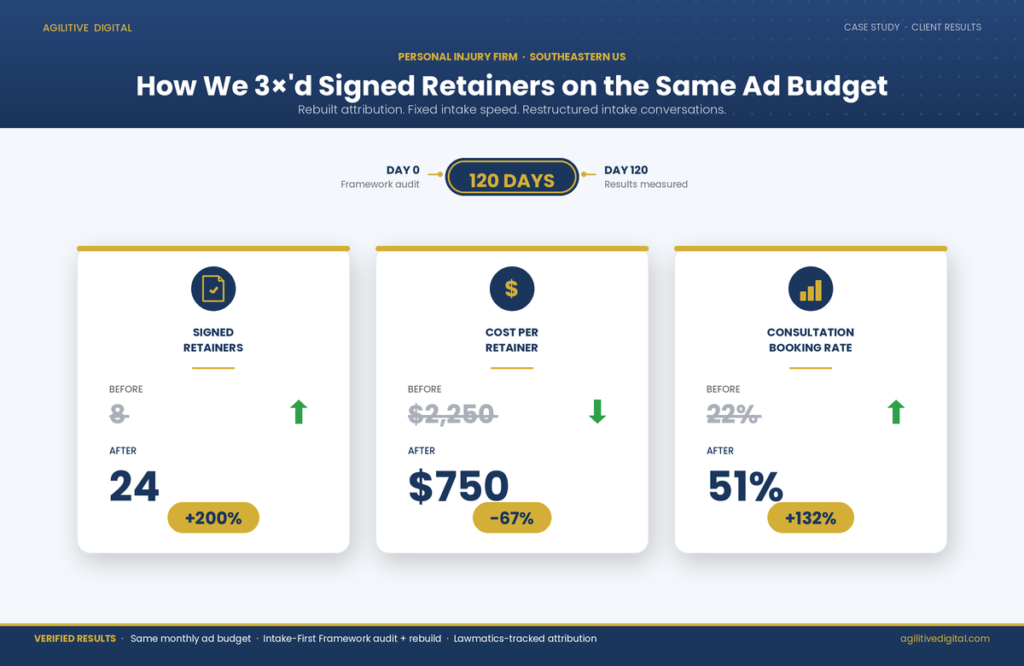
Results (measured at day 120):
- Website form submissions decreased from 90 to 62 per month (Qualification Design filtered out low-quality inquiries)
- Signed retainers increased from 8 to 24 per month (3x)
- Cost per signed retainer dropped from $2,250 to $750
- Intake conversation-to-consultation booking rate improved from 22% to 51%
- The firm reinvested the efficiency gains into scaling ad spend to $28,000 per month, generating 38 signed retainers in month 6
These results reflect a specific client engagement. Individual firm results vary based on practice area, market competition, ad spend, and starting operational maturity.
The Intake-First Framework Diagnostic Checklist
Use this checklist to score your firm against each pillar. Score 1 point for each “yes.” A firm scoring 15 or above is operating the full framework. A firm scoring under 10 has significant optimization opportunities.
| Pillar | Diagnostic Question | Score |
| Attribution Truth | Do you know the cost per signed retainer by traffic source? | ___ |
| Attribution Truth | Is call tracking (with DNI) implemented across all traffic sources? | ___ |
| Attribution Truth | Are signed retainers pushed back into ad platforms as conversions? | ___ |
| Attribution Truth | Can you produce a report showing keywords by signed retainer volume? | ___ |
| Qualification Design | Does your form use conditional logic to adapt to case type? | ___ |
| Qualification Design | Do you ask at least 5 qualifying questions before form submission? | ___ |
| Qualification Design | Is your intake team spending less than 30% of time on unqualified leads? | ___ |
| Speed-to-Contact | Is your average response time under 5 minutes during business hours? | ___ |
| Speed-to-Contact | Do intake specialists receive SMS alerts for new leads? | ___ |
| Speed-to-Contact | Do you have dedicated intake capacity covering peak hours (8am to 8pm)? | ___ |
| Intake Choreography | Is there a documented intake script every specialist follows? | ___ |
| Intake Choreography | Do you record intake calls and review at least 5 per week per specialist? | ___ |
| Intake Choreography | Do you track intake conversation-to-consultation booking rate? | ___ |
| Retainer Signing Path | Do you use e-signature tools for all retainer agreements? | ___ |
| Retainer Signing Path | Is your retainer signable on mobile in under 10 minutes? | ___ |
| Retainer Signing Path | Do you have automated follow-up for unsigned retainers within 7 days? | ___ |
| Retainer Signing Path | Do you accept online retainer deposits via LawPay or similar? | ___ |
Total score: ___ / 17
Frequently Asked Questions
Conclusion
Conversion rate optimization for law firms produces disappointing results when it borrows tactics from e-commerce and applies them to a fundamentally different buyer journey. The Intake-First Framework rejects that borrowing. It recognizes that legal buyers convert through operational stages, not just website interactions, and that the highest-leverage optimizations happen in the 5 minutes after a form submission, in the structure of the intake conversation, and in the friction between verbal commitment and signed retainer. Firms operating the full framework consistently convert 3 to 5 times more retainers from identical traffic volume, because they are optimizing the entire path from click to case rather than the first step in isolation.
Agilitive Digital is a 100% law-firm-focused agency. We work exclusively with attorneys, we have managed over $10M in ad spend for legal clients, and our 97.5% retention rate reflects a track record of delivering measurable case acquisition results. The Intake-First Framework is the methodology we apply on every engagement.
If your firm is investing in marketing but signed retainer volume has plateaued, the problem is almost certainly a broken pillar in the framework.
Book a free Intake-First Framework audit with Agilitive Digital and we will show you exactly which pillars are underperforming and the specific fixes that will produce the highest returns.