
Your firm can rank first for “personal injury lawyer” nationally and still lose every case to a smaller competitor across town. Why? Because nobody types “personal injury lawyer” when they need one. They type “personal injury lawyer near me,” and Google’s answer comes from an entirely different ranking system than the one your general SEO strategy targets.
That system is local search. It uses proximity, prominence, and relevance to decide who appears in the three-result map pack that sits above traditional search results. The firms winning local search are not necessarily the biggest or the most established. They are the ones who understand that local SEO for law firms operates on rules that generic SEO advice does not touch.
At Agilitive Digital, we have managed over $10M in ad spend exclusively for law firms, and one pattern is unmistakable: firms that invest in local SEO outperform firms that invest in generic SEO by 3 to 5 times on consultation volume in the same metro area.
This guide walks you through the exact tactics that move law firms into the map pack, capture “near me” search intent, and convert local searchers into signed retainers.
Quick Answer
Local SEO for law firms is the practice of optimizing your firm’s online presence to rank in Google’s local map pack and location-specific searches. Unlike traditional SEO, local SEO relies on Google Business Profile optimization, local citations, geo-targeted content, review velocity, and proximity-based signals. Law firms that master local SEO consistently capture more high-intent local searchers than firms competing on national-level keywords alone.
What Local SEO Means for Law Firms?
Local SEO is a distinct discipline that governs how your firm appears in searches with local intent. When someone types “family law attorney Dallas,” “criminal defense lawyer near me,” or “estate planning attorney open now,” Google runs a different algorithm than it uses for “how to file for divorce.” The local algorithm cares about three things: proximity to the searcher, prominence of your firm in the local area, and relevance of your firm to the specific query.
For law firms, this matters more than it does for almost any other industry. Legal services are inherently local. Attorneys need to be licensed in the state where they practice. Clients often want an in-person consultation. Court appearances happen at specific courthouses. A firm ranking well for local searches in Houston does nothing for its competitors in Dallas, and vice versa.
The distinguishing fact most attorneys miss: local SEO for law firms is not just “SEO plus a location word.” Adding “Dallas” to your keyword strategy does not make you competitive in Dallas local search. Ranking in the map pack requires signals that traditional SEO does not generate, including verified business information, citation consistency, review velocity, and Google Business Profile optimization. Firms that treat local SEO as an extension of general SEO consistently lose to firms that treat it as its own discipline.
Why Local SEO Matters More Than General SEO for Law Firms?
The Search Behavior Reality
Legal services are the highest-intent category in local search. When a car accident victim searches for “personal injury lawyer” on their phone from a hospital bed, they are not researching. They are looking for someone to call within the hour. Google’s data confirms this pattern across local search broadly: the majority of mobile local searchers contact or visit a business within 24 hours of their search. That intent is captured by local search, not by ranking on generic terms.
The Map Pack Dominance
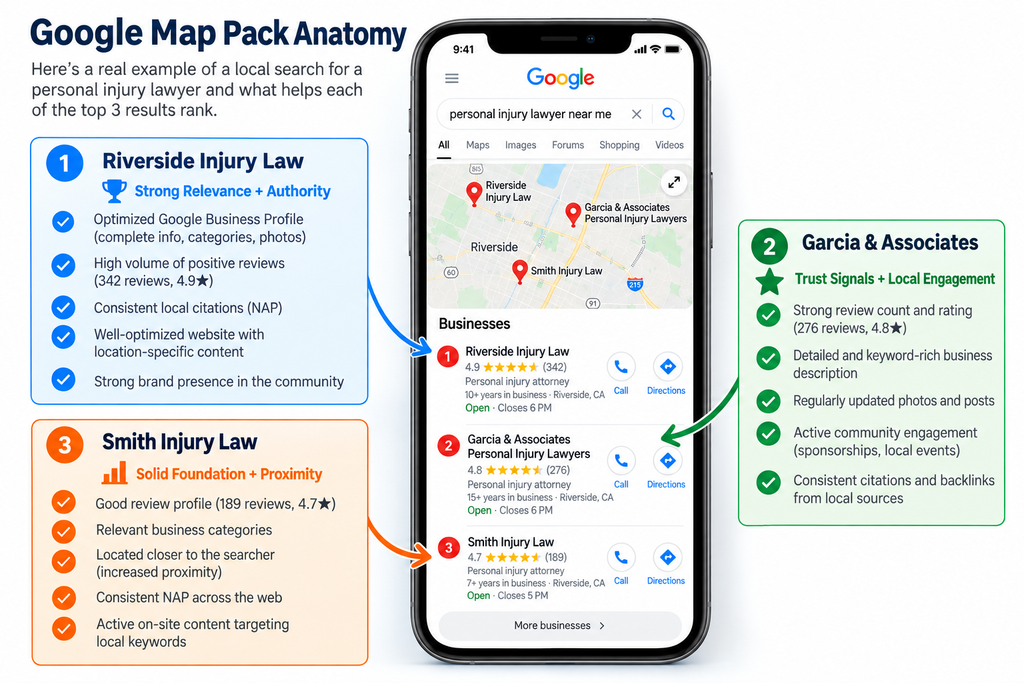
The three-firm map pack that appears at the top of local searches captures nearly half of all local search clicks. According to First Page Sage’s 2025 click-through rate research, the first map pack position alone receives 17.6% of clicks, position two receives 15.4%, and position three receives 15.1%. Combined, the three visible map pack results capture more attention than the top organic result and paid ads combined.
Everything below the map pack, including your paid Google Ads and organic rankings, fights for the leftover attention. If your firm is not in the map pack for your primary practice area in your metro, you are competing for scraps against firms that are. And the firms in the map pack are typically small to mid-sized local practices, not the “billboard firms” spending millions on brand advertising.
The Economics Only Local Firms Understand
Law firms competing for map pack visibility spend nothing per click. The impressions and traffic are free once you rank. Contrast that with Google Ads, where personal injury clicks routinely cost $150 to $250 each. A firm ranking in the map pack for “car accident lawyer Chicago” captures dozens of high-intent leads per month at zero marginal cost. A firm relying purely on paid ads for the same visibility spends thousands per month to reach the same audience. Over a 12-month period, local SEO investment produces cost-per-acquisition that paid channels cannot match for the same intent quality.
The 6 Pillars of Local SEO for Law Firms
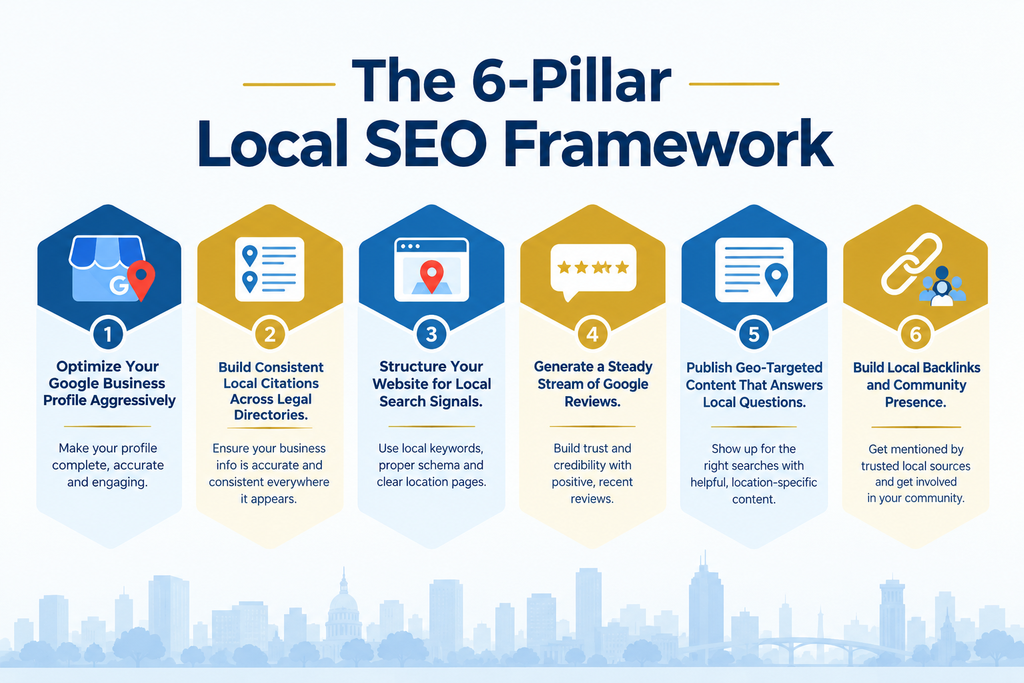
Local SEO for law firms is not a single tactic. It is a coordinated set of six work streams that reinforce each other. Firms that master all six consistently dominate their local markets. Firms that execute only one or two see limited results.
Pillar 1: Optimize Your Google Business Profile Aggressively
Google Business Profile (GBP) is the single most important asset in local SEO. It powers your appearance in the map pack, controls your Knowledge Panel when someone searches your firm by name, and feeds critical signals to Google’s local algorithm. Neglecting GBP is the fastest way to lose local visibility.
Start with the fundamentals: your business name must match your bar-registered firm name exactly (Google penalizes keyword-stuffed names), your primary category must reflect your dominant practice area (not the generic “Law Firm” category), and you should add up to 10 secondary categories covering every practice area your firm actively handles. Complete every profile field, including hours, phone number, website, and a business description that includes your primary keyphrase within the first 250 characters.
The insider tactic most firms miss: use Google Posts weekly. Firms with active Post publishing outrank firms with static profiles because Google treats posting frequency as a freshness signal. At Agilitive Digital, we require every client to publish a minimum of one Post per week, covering firm updates, case results (with ABA-compliant framing), community involvement, or educational content about their practice areas.
For a deeper walkthrough, see our complete Google Business Profile playbook for law firms, which covers verification, review strategy, and category selection in detail.
Pillar 2: Build Consistent Local Citations Across Legal Directories
A citation is any online mention of your firm’s name, address, and phone number (NAP). Google uses citation consistency as a trust signal. If your firm shows up as “Smith and Associates, 123 Main St, (713) 555-0123” on one site and “Smith & Associates PLLC, 123 Main Street, (713) 555-0123” on another, Google gets confused about which version is authoritative and reduces your local ranking confidence.
For law firms specifically, prioritize these citation sources in this order: your state bar directory, Avvo, Justia, FindLaw, Martindale-Hubbell, Super Lawyers, LawInfo, and the Better Business Bureau. Then extend to general directories: Yelp, Yellowpages, Chamber of Commerce, and industry-specific directories relevant to your practice areas.
The insider tactic: audit your NAP variations quarterly. Firms that never audit typically have 15 to 30 inconsistent citations across the web, quietly weakening their local rankings. Use a tool like BrightLocal or Whitespark to identify variations, then submit corrections through each platform’s business owner interface.
Pillar 3: Structure Your Website for Local Search Signals
Your website reinforces or undermines every other local SEO signal. Google looks for specific technical patterns that confirm your firm is a legitimate local business in your claimed service area.
Add LocalBusiness and Attorney schema markup to your website’s contact page and footer. This structured data helps Google verify your NAP matches your GBP listing and other citations. Include your city and state in your title tags on your homepage and location pages. Embed a Google Map on your contact page. Publish an “About” page that mentions your service area, the courts you practice in, and your local community involvement.
The insider tactic: for multi-location firms, build a dedicated location page for each office at URLs like /locations/houston/ or /offices/dallas/. Each page should have unique content covering the specific attorneys at that location, cases handled from that office, the local courts served, and specific neighborhoods within that service area. Duplicated location pages with only the city name swapped in the template get flagged by Google’s helpful content system and rank poorly.
Pillar 4: Generate a Steady Stream of Google Reviews
Reviews are the second-most powerful local ranking factor after GBP optimization. Google’s local algorithm uses total review count, average rating, review velocity (how often new reviews arrive), and review response rate as ranking signals. A firm with 200 reviews averaging 4.8 stars will outrank a firm with 40 reviews averaging 5.0 stars in most local searches.
The critical constraint for law firms: ABA Model Rule 7.2(b) prohibits giving anything of value in exchange for a review. No discounts, no gifts, no priority scheduling. Doing so risks state bar discipline. What you can do is systematically ask for reviews at moments of natural client satisfaction, typically at case closure with a favorable outcome.
Use your case management system to trigger review requests automatically. Clio, Lawmatics, and HubSpot all support automated post-matter review request workflows. Aim for review velocity (new reviews every 7 to 14 days) rather than sporadic bursts. Respond to every review within 48 hours using legally compliant response templates that never mention specific case details, which could waive attorney-client privilege.
Pillar 5: Publish Geo-Targeted Content That Answers Local Questions
Local content is what separates firms that dominate specific practice-area-plus-city searches from firms that only rank for their firm name. Google needs signals that your firm is an authority on legal questions specific to your service area.
Build a content strategy around locally relevant queries: state-specific legal questions (“Texas statute of limitations for personal injury”), city-specific procedural questions (“how to file a divorce in Harris County”), neighborhood-specific practice area content (“estate planning attorney River Oaks Houston”), and local news commentary (“what the new Texas driving law means for accident claims”).
The insider tactic: create content that ties your practice area to local landmarks, events, or legal developments. A personal injury firm in Chicago should publish content about accidents on Lake Shore Drive, the Kennedy Expressway, and O’Hare-area collisions. A family law firm in Miami should publish content about Miami-Dade family court procedures. This kind of content ranks well because national publishers cannot compete for the local specificity, and it captures searchers who trust local expertise over national brand recognition.
Pillar 6: Build Local Backlinks and Community Presence
Local backlinks are hyperlinks from other local websites pointing to your firm. Google treats them as local authority signals. A backlink from your local chamber of commerce, a legal aid organization in your city, or a local news site is more valuable for local SEO than a backlink from a national industry publication.
Build these through legitimate local relationships: sponsor local events and get listed on their websites, join local bar associations and appear in their member directories, offer to provide legal commentary to local news outlets, participate in community organizations aligned with your practice area, and partner with complementary local businesses (a personal injury firm might partner with local chiropractic clinics or physical therapy practices for cross-referrals and mutual mentions).
The insider tactic: audit your competitors’ local backlink profiles using Ahrefs or SEMrush. Identify which local sites link to them but not to you, then pursue those same relationships. This gap analysis often reveals 20 to 40 winnable local backlinks that competitors have already validated.
Need help executing a local link-building campaign?
We handle local authority building, directory audits, and backlink outreach for law firms. Schedule a free strategy session with the Agilitive team today.
Common Mistakes Law Firms Make with Local SEO
Mistake 1: Treating GBP as a One-Time Setup
Most firms claim their Google Business Profile, fill in the fields, and never touch it again. This is the single most damaging local SEO mistake. Google’s local algorithm rewards active profile management. Firms that post weekly, respond to reviews within 48 hours, update photos monthly, and answer Q&A regularly consistently outrank firms with equivalent profiles that sit static.
How to avoid it: Assign GBP ownership to a specific person on your marketing team. Build a weekly checklist. Track posting frequency and response times as KPIs.
Mistake 2: Keyword-Stuffing the Business Name
Firms desperate to rank add practice area keywords or city names to their GBP business name, hoping Google will reward them. Google explicitly prohibits this, and enforcement has tightened significantly since 2023. A profile flagged for name stuffing gets suspended, and reinstatement takes 30 to 60 days. During that suspension, your firm disappears from map pack results entirely.
How to avoid it: Use your legally registered firm name. Nothing more. If your firm is registered as “Smith and Associates PLLC,” your GBP name is exactly that.
Mistake 3: Building Thin, Duplicated Location Pages
Multi-location firms often build /locations/city-name/ pages using a template that swaps the city name but keeps everything else identical. Google’s helpful content system flags this pattern as low-value and either ignores the pages entirely or actively suppresses them. The firm ends up with dozens of pages competing for local queries and none of them ranking.
How to avoid it: Each location page needs unique, substantive content covering the specific attorneys at that location, the courts they practice in, cases handled from that office, and specific neighborhoods served. A minimum of 800 unique words per location page, ideally 1,500 or more.
Mistake 4: Chasing High-Volume Head Terms Instead of Local Long-Tail
Firms invest heavily in ranking for terms like “personal injury lawyer” or “family attorney” and ignore the long-tail local queries that actually convert. A firm ranking third for “personal injury lawyer Houston Heights” captures more qualified leads than a firm ranking eighth for “personal injury lawyer” nationally.
How to avoid it: Build content and location pages targeting specific neighborhoods, practice-area combinations, and local intent modifiers. Track rankings for these long-tail terms as your primary KPIs.
Mistake 5: Low Profile Activity Signals
Treating GBP as a static listing rather than an active channel damages trust. Ignoring reviews or leaving visual assets untouched for months suppresses your local search reach and drives prospects to active competitors.
How to avoid it: Treat review responses and photo updates as standard intake operations. Maintain a 48-hour review response policy and schedule monthly visual uploads (headshots, office environment) to continuously feed Google’s activity algorithm.
Want to turn your local profile into a consistent lead driver?
We build and manage high-visibility local SEO strategies designed exclusively to generate signed retainers. See how our Law Firm SEO Services can scale your firm.
Real Results: How a Family Law Firm Won the Map Pack in 90 Days
Client type: A mid-sized family law firm in the Dallas-Fort Worth metroplex handling divorce, custody, and estate planning.
Problem: The firm had a claimed but neglected Google Business Profile with 14 reviews, no photos beyond a logo, and an incorrectly chosen primary category (“Law Firm” instead of “Family Law Attorney”). Their website had no location page structure. Their citations across legal directories showed 22 different NAP variations. They ranked in the map pack for zero commercially valuable queries in their metro area. New client intake was 92% referral-driven, with almost nothing coming from organic Google visibility.
Approach: Over 90 days, we implemented four of the six local SEO pillars:
- GBP Optimization: Corrected the primary category to “Family Law Attorney,” added five secondary categories, uploaded 38 photos, and established weekly Google Post publishing
- Citation Cleanup: Standardized NAP across 27 directories including state bar, Avvo, Justia, FindLaw, Martindale-Hubbell, and general business directories
- Location Page Build: Created dedicated location pages for each of the firm’s two offices with 1,800+ unique words per page covering local court procedures, attorney bios, and neighborhood service areas
- Review Automation: Built a Lawmatics workflow triggering review requests at case closure, generating 3 to 5 new reviews per week within ABA compliance
Results (measured at day 90):
- Map pack visibility rose from 0 tracked queries to 47 queries in the top 3 map pack
- Total GBP-driven phone calls increased from 6 per month to 31 per month
- Review count grew from 14 to 42 (average rating remained 4.9)
- Consultation requests from local organic search grew from 2% of new intake to 24% of new intake by day 90
These results reflect a specific client engagement. Individual firm results vary based on market competition, practice area, geographic scope, and starting operational maturity.
The Local SEO Diagnostic Checklist for Law Firms
Use this checklist to audit your firm’s local SEO. Each pillar scored below 3 out of 4 indicates a high-leverage optimization opportunity.
| Pillar | Diagnostic Question | Yes/No |
| GBP | Is your business name your exact bar-registered firm name? | ___ |
| GBP | Is your primary category your dominant practice area (not “Law Firm”)? | ___ |
| GBP | Are you publishing Google Posts at least weekly? | ___ |
| GBP | Do you have at least 20 photos uploaded, refreshed within the last 90 days? | ___ |
| Citations | Is your NAP identical across all major legal directories (state bar, Avvo, Justia, FindLaw)? | ___ |
| Citations | Have you claimed your listing in the top 15 general business directories? | ___ |
| Website | Is Attorney or LocalBusiness schema markup implemented on your contact page? | ___ |
| Website | Does each office location have a dedicated page with 800+ unique words? | ___ |
| Reviews | Are you generating new reviews on at least a weekly basis? | ___ |
| Reviews | Do you respond to every review within 48 hours? | ___ |
| Reviews | Do your review responses stay compliant with ABA and state bar rules? | ___ |
| Content | Do you publish content targeting local practice-area queries (city + service)? | ___ |
| Content | Does your content reference local courts, landmarks, or legal developments? | ___ |
| Backlinks | Do you have backlinks from at least 5 local organizations or news sources? | ___ |
| Backlinks | Are you actively participating in local bar associations with directory listings? | ___ |
| Tracking | Are you tracking rankings for local long-tail queries (not just head terms)? | ___ |
| Tracking | Are you measuring calls and consultations attributed to organic local search? | ___ |
Total score: ___ / 17
Firms scoring 12 or above are executing local SEO at a competitive level. Firms scoring under 8 have significant optimization opportunities that competitors are likely capturing right now.
Here is a streamlined, precise version of your Local SEO FAQ section with the study verification tag removed and answers formatted for maximum scannability:
Frequently Asked Questions
How Is Local SEO For Law Firms Different From Regular SEO?
General SEO relies on backlinks, content depth, and technical site structure to rank nationally. Local SEO focuses on driving map pack visibility within a specific metro area through Google Business Profile optimization, strict NAP consistency, review velocity, and geo-proximity signals.
How Long Does Local SEO Take To Produce Results For A Law Firm?
Initial map pack improvements typically appear within 30 to 60 days. Meaningful increases in calls and consultations emerge between 60 and 120 days. Results materialize faster in secondary markets, while major metros like Los Angeles or Chicago take longer due to entrenched competition.
Should My Firm Prioritize Local SEO Or Google Ads?
Build your Local SEO foundation first, then layer Google Ads on top. Local SEO delivers sustainable, compounding value over time, whereas Ads provide immediate leads but stop the moment spend stops. Combining both yields significantly lower costs per signed retainer than relying on paid ads alone.
Are There ABA Compliance Rules That Affect Local SEO Tactics?
Yes. ABA Model Rule 7.2(b) strictly prohibits offering incentives, discounts, or gifts in exchange for client reviews. Furthermore, Model Rule 7.1 requires that all website testimonials and case results include clear disclaimers to prevent misleading expectations. Always review your specific state bar guidelines.
Where Should Our Firm Start With Local SEO For Law Firms?
Begin by optimizing your Google Business Profile: select the correct primary category, upload 20+ fresh photos, and publish weekly updates. Next, audit your NAP consistency across major legal directories. Together, these two steps drive the majority of initial ranking gains within the first 90 days.
Conclusion
Winning a local search for your law firm is not about tricks or shortcuts. It comes down to six coordinated work streams: aggressive Google Business Profile optimization, consistent NAP across local citations, structural website signals for local search, systematic review generation, geo-targeted content that answers local questions, and local backlinks that build community authority. Firms that execute all six consistently outperform 80% of their local competition within 6 to 12 months, and the compounding nature of local SEO means the advantage grows every quarter.
Local SEO for law firms is not optional. The map pack captures nearly half of all clicks on high-intent local searches, and firms invisible to those searches are ceding the highest-value part of their local market to competitors who take local SEO seriously.
Agilitive Digital is a 100% law-firm-focused agency. We work exclusively with attorneys, we have managed over $10M in ad spend for legal clients, and our 97.5% retention rate reflects a track record of delivering measurable case acquisition results through local SEO, PPC, and intake optimization.
If your firm is not appearing in the map pack for your primary practice area in your metro, something in the six pillars is broken.
Book a free local SEO audit with Agilitive Digital and we will show you exactly which pillars are underperforming and the specific fixes that will produce the highest returns in the next 90 days.