
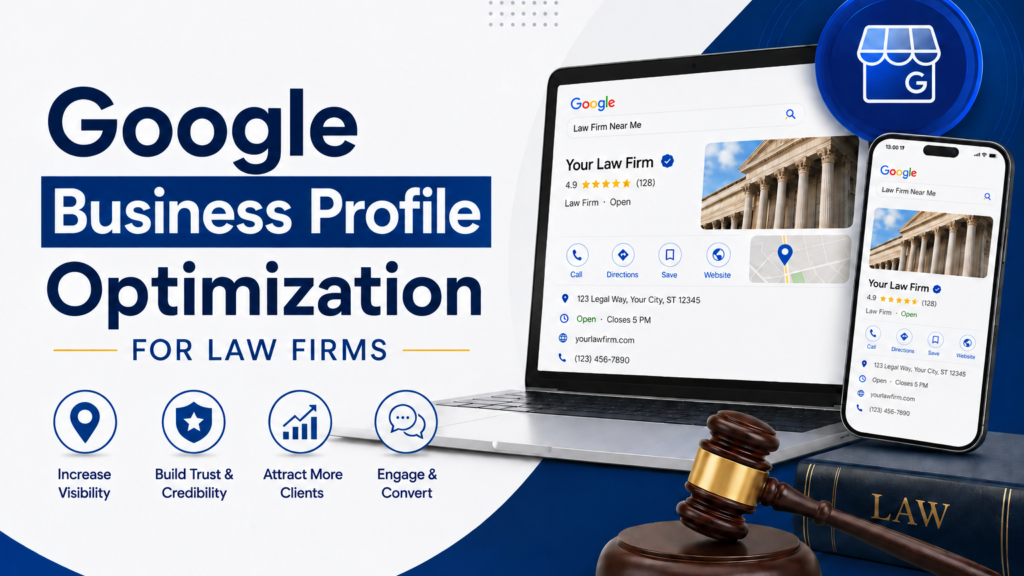
When someone needs a lawyer, Google is often one of the first places they turn.
A potential client might search for “personal injury lawyer near me,” “divorce attorney in Dallas,” or “criminal defense lawyer nearby.” For searches like these, Google may display local businesses prominently in Search and Maps. For law firms, that makes Google Business Profile an important part of local search visibility.
A well-managed profile can help prospective clients find your firm, understand what you do, read reviews, get directions, visit your website, and contact your office. However, simply claiming a profile is not enough. Google says local results are primarily determined by three factors: relevance, distance, and prominence. Complete and accurate business information, reviews, links, and other signals can influence how Google understands and displays a local business.
This guide explains how Google Business Profile optimization for law firms works, what actually matters, and how to build a profile that supports your broader local SEO strategy.
Quick Answer
Google Business Profile optimization for law firms is the process of accurately configuring, improving, and maintaining a law firm’s listing on Google Search and Google Maps.
Optimization typically includes:
- Choosing accurate business categories
- Maintaining correct contact and location information
- Managing client reviews
- Adding relevant photos
- Keeping services and business information current
- Publishing useful profile updates when appropriate
- Connecting the profile with a well-optimized law firm website
- Monitoring performance and local visibility
Google does not publish every detail of its local ranking algorithm. However, it explicitly identifies relevance, distance, and prominence as the main factors used to determine local rankings.
What Is Google Business Profile Optimization?
Google Business Profile, formerly Google My Business, allows eligible businesses to manage how they appear across Google Search and Google Maps. A law firm’s profile can include information such as:
- Business name
- Address
- Phone number
- Website
- Office hours
- Practice categories
- Services
- Photos
- Reviews
- Business updates
Google Business Profile optimization is the ongoing process of making sure that information accurately represents the firm while helping Google understand when the firm may be relevant to a local search. This is important because local search rankings do not work exactly the same way as traditional organic search rankings.
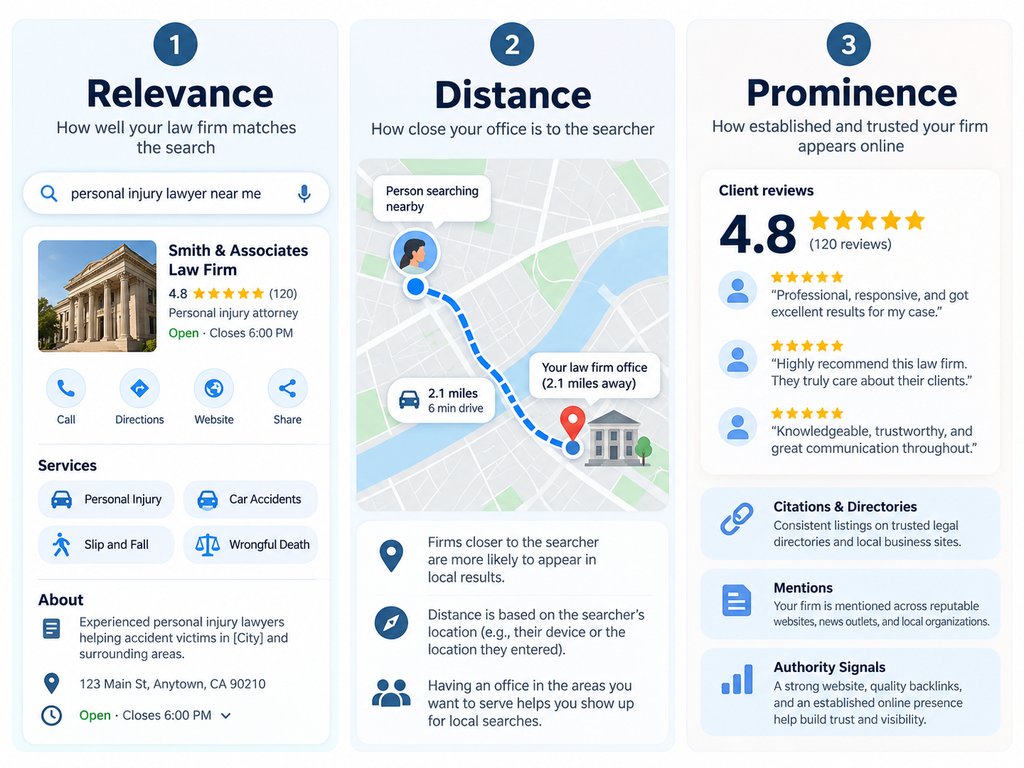
Google identifies three broad local ranking considerations:
Relevance: Relevance refers to how closely a business matches what someone is searching for. Providing complete and detailed business information can help Google better understand your firm and connect it with relevant searches.
Distance: Distance considers how far a business is from the searcher or from the location included in the search. This is one factor a law firm cannot completely optimize around. A firm located several miles from a searcher may not appear as prominently as a relevant competitor closer to that person.
Prominence: Prominence reflects how well known a business is. Google says factors such as links, reviews, review ratings, and other information about the business can contribute to prominence. More reviews and positive ratings can also help a business’s local ranking.
Why Does Google Business Profile Matters for Law Firms?
Legal searches frequently have strong local intent. Someone searching for a lawyer usually wants a firm that serves their city, county, or surrounding area. Even when the search does not include a city name, Google may interpret the query as local based on the searcher’s location and intent. Google Business Profile gives law firms a way to compete for that visibility.
Is your law firm invisible in local map searches?
Don’t let prospective clients go to local competitors with active listings. Reach out to Agilitive Digital to build a tailored Google Business Profile strategy that converts local searches into signed case.
It Can Put Your Firm in Front of High-Intent Searchers
A person searching for a specific type of attorney in their area is often further along in the decision process than someone casually researching a legal topic. A strong Business Profile can provide important information without requiring the searcher to visit several websites first.
They may immediately see:
- Your practice area
- Location
- Reviews
- Office hours
- Phone number
- Website
- Directions
This reduces friction between the search and the first contact with your firm.
Organic Local Visibility Does Not Require Paying Google Per Click
Google does not charge businesses for appearing organically in local results. That does not mean local SEO is free. Building and managing a strong local presence requires time, content, reputation management, website optimization, and sometimes professional support. However, unlike Google Ads or Local Services Ads, there is no direct charge from Google every time someone clicks an organic Business Profile result.
GBP Supports More Than Rankings
Google Business Profile should not be viewed only as a ranking tool. Even when someone already knows your firm’s name, your Business Profile can influence how they perceive the business. Reviews, photos, hours, contact information, and other profile details can all help a potential client decide whether to contact your firm.
How to Optimize a Law Firm’s Google Business Profile?
GBP optimization works best as a collection of ongoing activities rather than a one-time checklist. The following areas deserve the most attention.
1. Get the Foundational Profile Information Right
Start with accuracy. Google recommends entering the business name as it appears in the real world on signage, stationery, branding, and other representations of the business. This is an important distinction. Your Google Business Profile does not necessarily need to reproduce every legal entity designation exactly as it appears in corporate registration documents. It should accurately reflect the name your firm genuinely uses in the real world.
Avoid adding extra keywords purely for ranking purposes. For example, if the firm’s real-world name is:
Smith & Associates
do not change the profile name to:
Smith & Associates Personal Injury Lawyers Dallas
unless that wording genuinely represents the firm’s established business name.
Keyword stuffing in a Business Profile name can violate Google’s guidelines.
You should also review:
- Address
- Phone number
- Website
- Office hours
- Holiday hours
- Appointment links
- Business description
- Services
Make sure the information is accurate and kept current.
2. Choose the Most Accurate Primary Category
Categories help Google understand what your business does. Google recommends selecting a primary category that specifically represents the core business. Businesses can also add up to nine additional categories when they accurately apply. For example, a law firm focused primarily on personal injury cases may be better represented by a specific available category such as:
Personal Injury Attorney
rather than relying only on a broader category such as:
Law Firm
A family law practice may similarly choose:
Family Law Attorney
when that best reflects its main area of practice.
Secondary categories can be added when the firm genuinely provides additional legal services. Avoid adding unrelated categories simply because they might generate additional visibility. The objective is not to select as many categories as possible. It is to select the fewest accurate categories needed to describe the firm’s core services, which is consistent with Google’s own guidance.
3. Build a Sustainable Review Strategy
Reviews are important for both potential clients and local search visibility. Google explicitly states that more reviews and positive ratings can help local rankings. Law firms should therefore have a consistent and ethical process for requesting reviews from clients.
Google allows businesses to ask customers for genuine reviews. However, it prohibits offering incentives such as discounts, free services, payments, or other benefits in exchange for posting, changing, or removing reviews.
Law firms have an additional consideration: professional conduct rules. ABA Model Rule 7.2 restricts lawyers from compensating people for recommending a lawyer’s services, subject to certain exceptions. Individual states may have additional or different rules governing attorney advertising, testimonials, recommendations, and review solicitation.
Before implementing an automated review program, law firms should therefore verify the applicable rules in their jurisdiction.
A practical review process might include:
- Asking satisfied clients for honest feedback at an appropriate stage
- Providing a direct Google review link
- Avoiding language that asks specifically for a five-star or positive review
- Never offering compensation or incentives
- Monitoring new reviews regularly
- Responding professionally when appropriate
Consistency is useful operationally, but avoid treating a specific “review velocity” target as a confirmed Google ranking requirement. Google does not publish a required review frequency.
4. Respond Carefully to Reviews
Google encourages businesses to respond to reviews because it shows customers that their feedback matters. For law firms, review responses require additional care because of confidentiality obligations. A seemingly harmless response can unintentionally reveal that someone was a client or disclose information about a legal matter.
Responses should remain general.
For example:
“Thank you for taking the time to share your feedback. We appreciate hearing from you.”
For a negative review, the firm may respond professionally without confirming whether the reviewer was actually a client.
Avoid discussing:
- Case details
- Consultation details
- Outcomes
- Communications
- Fees
- Personal circumstances
When in doubt, have the firm’s attorney or compliance team review the response.
5. Add Useful, Authentic Photos
Photos help prospective clients understand what to expect from your firm. Useful law firm photos may include:
- Office exterior
- Reception area
- Conference rooms
- Attorney headshots
- Team photographs
- Community events
- Speaking engagements
- Relevant branded materials
The objective should be to represent the real firm accurately. Avoid relying entirely on stock photos.
Google encourages businesses to maintain accurate photos and videos as part of their Business Profile information. Fresh photos can also make the profile more useful and reassuring to prospective clients, even though Google does not state that uploading a specific number of photos every month directly improves rankings.
6. Use Google Posts for Client Communication
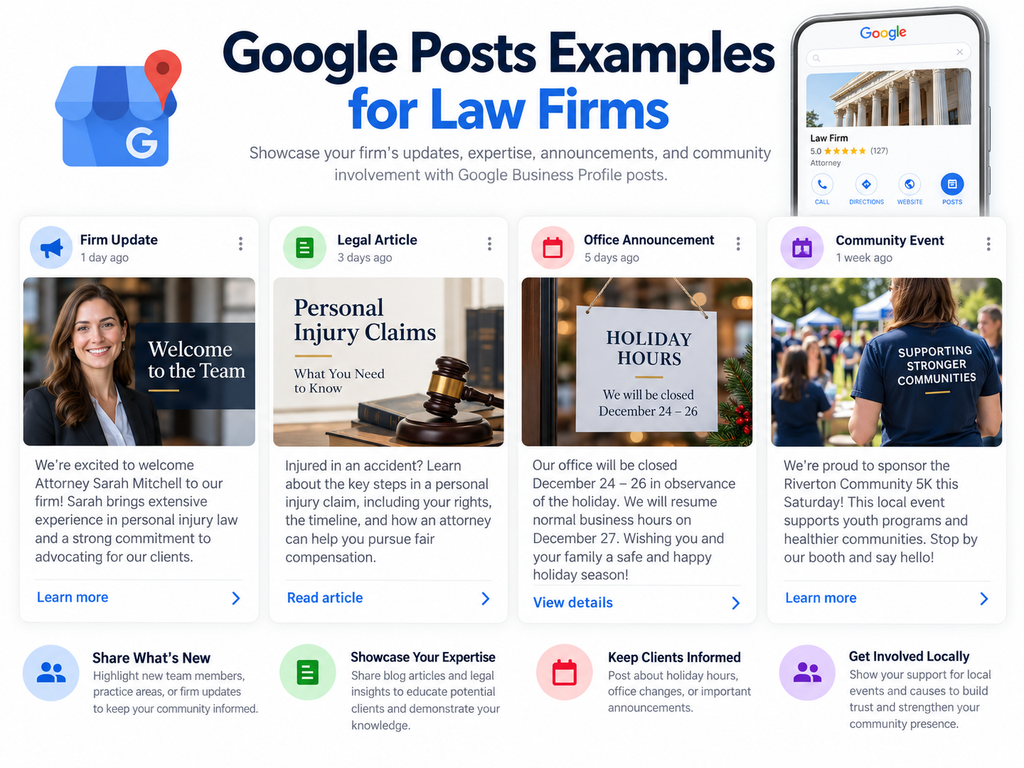
Google Business Profile allows businesses to publish updates, offers, and events. Posts can be useful for sharing:
- Firm news
- New attorneys
- Community involvement
- Educational articles
- Office announcements
- Events
- Important legal updates relevant to the firm’s audience
Google states that posts older than six months are archived unless a date range has been specified. This is different from older guidance suggesting that ordinary Google Posts disappear after seven days. There is also no confirmed Google guidance stating that publishing every week directly improves local rankings. Use Posts because they can keep the profile informative and current for prospective clients, not because of an assumed posting-frequency ranking bonus.
7. Keep Services and Website Content Aligned
Your Google Business Profile does not exist in isolation. The firm’s website should reinforce the same business information and practice areas represented on the profile.For example, if a firm selects “Family Law Attorney” as its primary category but its website barely mentions family law, the overall online presence sends inconsistent signals to users and search engines. A strong law firm website should have clear pages explaining important practice areas and locations.
Examples might include:
- Divorce attorney
- Child custody attorney
- Personal injury attorney
- Criminal defense attorney
- DUI attorney
Location pages should only be created when they provide meaningful, unique information for the people served in those areas. Avoid publishing dozens of near-identical city pages simply to target local keywords.
8. Maintain Accurate Business Information Across Important Platforms
Your firm’s core information should be accurate wherever clients are likely to encounter it. This may include:
- Firm website
- State bar profile
- Avvo
- Justia
- FindLaw
- Bing Places
- Apple Business Connect
- Relevant legal directories
- Local business directories
The goal is business identity consistency. Do not become overly concerned about insignificant formatting differences such as:
- “Street” versus “St.”
- “Avenue” versus “Ave.”
- Different suite formatting
What matters more is that users and search engines encounter accurate information about the same legitimate business. Incorrect phone numbers, outdated addresses, duplicate listings, and contradictory business names deserve much more attention.
9. Use Structured Data Appropriately
Structured data can help Google understand information about a business and its website. Google supports LocalBusiness structured data for eligible local businesses and recommends providing accurate properties such as the business name, address, telephone number, URL, and other relevant information. For a law firm’s website, structured data may help clarify information about the organization and its locations.
However, schema markup should not be presented as a guaranteed Google Maps ranking tactic. Its primary purpose is to give search engines structured information about the business and content. Use valid markup, follow Google’s structured data guidelines, and test implementation using Google’s available validation tools.
10. Track the Right GBP Performance Indicators
Optimization should be measured. Useful metrics may include:
- Calls
- Website visits
- Direction requests
- Profile interactions
- Search visibility
- Review growth
- Local keyword rankings
- Consultation submissions
- Signed clients originating from local search
For firms using advanced attribution, GBP website URLs can also include UTM parameters so traffic can be identified more clearly inside analytics platforms. Call tracking may be useful as well, provided the setup does not create inconsistent or misleading business information. The goal should eventually move beyond “How many people viewed the profile?” toward:
How many qualified leads and clients did local search contribute?
That is a much more meaningful business metric.
Small errors in category selection or profile setup can cost your firm top rankings. Get in touch with Agilitive Digital to get a comprehensive GBP audit and custom local optimization strategy for your law firm.
Common Google Business Profile Mistakes Law Firms Make
Mistake 1: Adding Keywords to the Business Name
Adding city names or practice-area keywords purely for SEO can violate Google’s Business Profile guidelines.
Better Approach: Use the firm’s genuine real-world business name. Build practice-area relevance through categories, services, website content, reviews, and other legitimate signals instead.
Mistake 2: Choosing Categories That Are Too Broad
Using only “Law Firm” when a more specific category accurately describes the firm’s primary practice can make it harder for Google and potential clients to understand the business.
Better Approach: Choose the most accurate specific primary category and add only genuinely relevant secondary categories.
Mistake 3: Asking Only Happy Clients for Positive Reviews
Law firms should request honest feedback rather than attempting to manufacture a perfect rating. Google’s policies require reviews to represent genuine experiences and prohibit incentives or rating manipulation.
Better Approach: Ask clients for an honest review without telling them what rating to leave.
Mistake 4: Ignoring Negative Reviews
A negative review is not automatically a disaster. A professional response can demonstrate that the firm takes feedback seriously.
Better Approach: Respond carefully when appropriate, without revealing confidential information or confirming details about representation.
Mistake 5: Trying to Remove Every Negative Review
Google generally does not remove a review simply because a business disagrees with it. Reviews should be reported when they appear to violate Google’s policies, such as fake engagement, conflicts of interest, harassment, or other prohibited content.
Better Approach: Document suspicious reviews, report legitimate policy violations, and respond professionally to genuine criticism.
Mistake 6: Treating GBP as a One-Time Setup
Business information changes. Attorneys join or leave firms. Office hours change. Practice areas evolve. Phone numbers change. New reviews appear.
Better Approach: Review the profile regularly and make updates when necessary. Google Business Profile should be treated as an actively managed business asset.
A Practical 90-Day GBP Optimization Roadmap
Rather than promising a specific ranking increase within a fixed period, law firms should approach GBP optimization systematically. Results will vary depending on factors such as competition, location, proximity, existing reputation, website authority, and the firm’s starting position.
Days 1 to 30: Fix the Foundation
Focus on accuracy first.
- Verify ownership and access
- Confirm the real-world business name
- Review address and phone details
- Update office hours
- Select the appropriate primary category
- Add relevant secondary categories
- Review the business description
- Add services
- Review website and appointment links
- Remove duplicate or inaccurate information
- Upload authentic firm photos
Days 31 to 60: Strengthen Reputation and Local Signals
Next, focus on the broader local presence.
- Create a compliant review-request process
- Start responding to reviews appropriately
- Audit important legal directories
- Correct outdated business information
- Improve important practice-area pages
- Review location pages
- Implement appropriate structured data
- Add UTM tracking to GBP website links
Days 61 to 90: Measure and Refine
Once the fundamentals are in place, start evaluating performance.
- Track calls and form submissions
- Review GBP interactions
- Monitor local search visibility
- Identify practice areas with weak visibility
- Compare visibility across target locations
- Continue acquiring genuine reviews
- Add useful photos and updates when available
- Improve corresponding website content
The objective is not to complete the checklist once. It is to establish a process that continuously keeps the firm’s local presence accurate, useful, and competitive.
Google Business Profile Optimization Checklist for Law Firms
| Task | Recommended Timing |
|---|---|
| Claim and verify the Business Profile | Initial setup |
| Confirm real-world business name | Initial setup |
| Verify address, phone and hours | Initial setup and ongoing |
| Select the most accurate primary category | Initial setup and periodic review |
| Add appropriate secondary categories | Initial setup and periodic review |
| Complete available profile information | Initial setup |
| Add authentic office and team photos | Initial setup and ongoing |
| Review important directory listings | Quarterly |
| Establish a compliant review process | Ongoing |
| Monitor and respond to reviews | Ongoing |
| Report reviews that violate Google policy | As needed |
| Publish useful Business Profile updates | As relevant |
| Keep services current | Ongoing |
| Maintain accurate website location information | Ongoing |
| Implement appropriate structured data | Initial setup and when site changes |
| Track local leads and conversions | Ongoing |
| Monitor local search visibility | Monthly or as needed |
Conclusion
Google Business Profile optimization isn’t about hidden tricks, it’s about clearly proving who your firm is, what services you offer, and where you practice. While you can’t control geographic distance, you can maximize relevance and prominence through accurate listings, strong review strategies, high-performing practice-area content, and precise conversion tracking. Treating your profile as a core asset rather than an isolated directory drives real client acquisition.
Agilitive Digital specializes in law firm marketing, local SEO, and measurable growth. If your profile isn’t generating qualified inquiries, contact us today for a comprehensive local SEO audit.
FAQ’s
Is Google Business Profile Free For Law Firms?
Yes. Google does not charge law firms to create or manage a Business Profile, but ongoing optimization still requires time, content, and maintenance.
How Long Does Google Business Profile Optimization Take To Work?
It depends on competition, location, reviews, and your current profile strength. Some improvements can appear quickly, but stronger local visibility usually takes consistent work over time.
What Are The Main Google Maps Ranking Factors?
Google identifies three main factors: relevance, distance, and prominence. Reviews, profile completeness, and overall business credibility can also influence visibility.
Should Law Firms Focus On Gbp Or Google Local Services Ads?
Both can be valuable. GBP supports organic local visibility, while LSAs provide paid exposure. The right mix depends on budget, competition, and lead goals.
Can Law Firms Ask Clients For Google Reviews?
Yes, as long as the request is genuine and no incentive is offered. Law firms should also follow their state bar advertising and ethics rules.
Do Google Posts Improve Local Rankings?
Google does not confirm posting frequency as a direct ranking factor. Posts are still useful because they keep your profile active and informative for potential clients.
Does Adding More Photos Improve Gbp Rankings?
Google encourages accurate photos, but it does not say that uploading more photos guarantees higher rankings. Photos mainly help build trust and improve profile quality.
Does Nap Information Need To Match Exactly Everywhere?
It should be accurate and consistent. Small formatting differences are usually less important than major issues like wrong phone numbers, outdated addresses, or duplicate listings.
What Happened To Google Business Profile Q&A?
Google changed the Q&A experience and discontinued the old Q&A API in 2025. Law firms should focus on keeping profile and website information complete and accurate rather than relying heavily on older Q&A tactics.